Cigna client acquisition & retention
| Enterprise Experience design – Cigna, 2021 – 2022

OVERVIEW
Problem: Clients expect healthcare providers to deliver benefit proposals that are affordable, personalized, comprehensive, and available within an accurate timeline so they can confidently support their employees. Limited transparency and delayed responses can put critical client relationships and revenue at risk. Internally, intake analysts, brokers, and underwriters were working across disconnected tools, fragmented workflows, and inconsistent data labels, contributing to proposal and implementation delays of up to two months.
Solution: A unified enterprise experience that connected critical healthcare benefit calculations, data sources, and decision points across the full lifecycle, from RFP and case build through installation and client onboarding. The experience consolidated provider, benefit, and account information into a more transparent and cohesive system, improving usability, workflow continuity, and confidence in decision-making.
My Role & Impact: As Team Lead and Lead UX Designer, I led the systems-level design of the enterprise B2B experience, translating complex healthcare workflows, fragmented data, and multi-role requirements into a scalable experience architecture. I aligned product, technology, business, and design teams around critical user and operational needs, shaping a more connected ecosystem experience across workflows supporting The Cigna Group’s $247B+ annual revenue ecosystem. The resulting experience increased task completion by 300% while improving workflow continuity, usability, and decision-making across the proposal lifecycle.
My scope included:
- Leading four global design teams with 12 direct and 3 indirect reports, setting strategic direction, priorities, and design alignment across a complex enterprise portfolio.
- Establishing weekly design reviews and a transparent intake model, improving consistency, cross-team support, and visibility into design demand and headcount needs.
- Aligning Product, Operations, Business, and Technology around priorities, requirements, and dependencies, giving design teams clearer visibility and confidence in execution.
- Unifying four fragmented intake, broker, and underwriting workflows into an end-to-end experience spanning RFP, case build, installation, and client onboarding.
- Simplifying experience architecture, benefit calculations, and data relationships across providers, benefits, and accounts, improving transparency, accuracy, and decision-making.
- Establishing a scalable enterprise experience foundation, increasing task completion by 100% and supporting faster, more consistent benefit-package delivery.

UX PROCESS

Discover
I partnered with product owners and managers to conduct research and testing with users across the workflow. This work uncovered several structural issues:
- experts were duplicating effort across siloed systems
- inconsistent labels and fragmented information slowed task completion
- role transitions introduced confusion and handoff friction
- adoption risk was tied not only to usability, but also to unfamiliarity and training concerns
These findings clarified that the core problem was not a single broken workflow, but a disconnected operating model that increased stress, reduced efficiency, and made the experience harder to trust.


UX strategy
Once the core pain points and opportunity areas were clear, I used the IBM Enterprise Garage framework to help shape a feasible, incremental strategy with product, business, and engineering.
This phase focused on aligning around:
- the highest-value workflows to address first
- the capabilities that needed to be unified
- how to sequence improvements in a way that balanced user value, feasibility, and business priority
- what the future-state experience architecture needed to support across roles and lifecycle stages
As a strong advocate for the customer experience, I contributed directly to planning and alignment conversations, helping ensure the proposed direction remained grounded in user needs while also being actionable for the organization.


UX structure
Once the core issues were clear, I focused on establishing the structural foundation the experience needed in order to scale.
This included defining:
- a clearer relationship between roles, tasks, and handoff points
- a more intuitive information hierarchy across key data sources
- a consistent model for how users would move through intake, proposal review, and underwriting decisions
- shared patterns and interaction logic that could reduce ambiguity across the system
This structure was essential because the experience had to support multiple user groups without becoming fragmented again. Rather than designing isolated screens, I worked to create a framework that brought coherence to the full lifecycle and made the product easier to understand, use, and extend over time.


IDeate
From there, I translated the strategy into role-based scenarios and end-to-end use cases centered on the most important product enablers.
The design work focused on:
- simplifying movement across complex workflows
- creating clearer information hierarchy and data relationships
- reducing cognitive load through more intuitive structure and labeling
- supporting role-specific needs without fragmenting the overall experience
I used rapid prototyping in Adobe XD and Figma to test concepts early, gather feedback quickly, and refine the experience based on actual user reactions. This helped de-risk assumptions, strengthen the architectural model, and improve confidence in the direction before implementation.


Build
In the final phase, I refined the visual system, documented process flows, and defined the UI components and interaction patterns needed to support consistent execution.
The resulting experience introduced a more modern, scalable, and intuitive framework for managing RFPs and benefit proposals. More importantly, it changed how experts engaged with the work by bringing clarity to fragmented tasks, making data easier to interpret, and helping teams move through complex processes with greater confidence and less friction.
The solution improved operational flow across intake analysts, brokers, and underwriters while creating a stronger enterprise foundation for future growth.
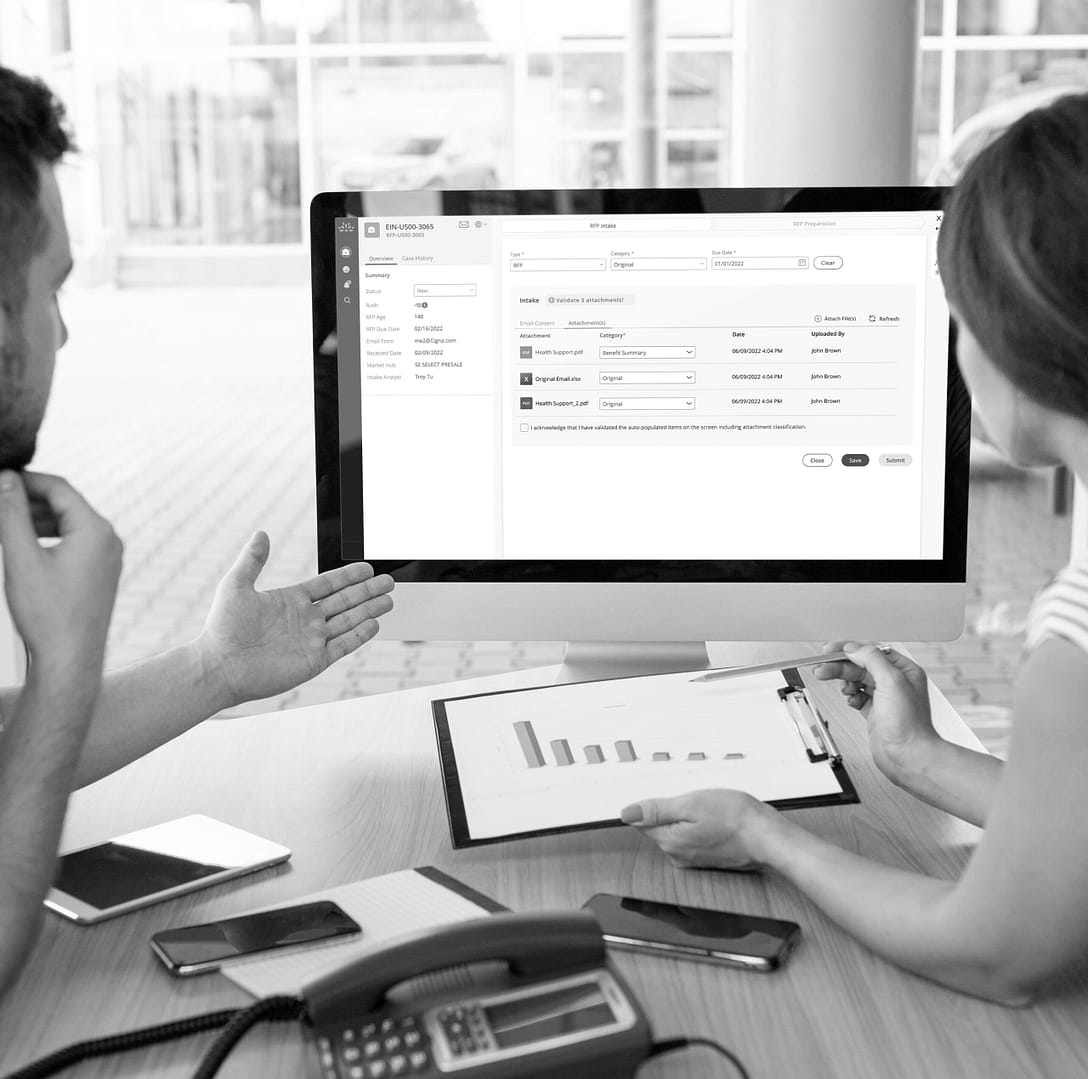
Intake analyst


Underwriter

Broker

IMPACT
The work delivered a 300% increase in task completion and established a stronger operational model for proposal and benefits management.
By unifying workflows, improving clarity across roles, and reducing duplication, the experience strengthened collaboration, improved usability, and created a more scalable foundation for future enterprise growth.