Cigna benefit orchestration
| Enterprise Experience design – Cigna, 2020 – 2021

OVERVIEW
OVERVIEW
Problem: Fortune 500 clients expect benefit pricing to be accurate, transparent, and delivered on time. However, limited pricing clarity, inconsistent documentation, and errors in benefit configuration can lead to downstream disputes, financial adjustments, and client dissatisfaction, ultimately putting long-term relationships and up to $100B in projected revenue exposure at risk.
Solution: Design a unified enterprise benefit pricing experience that connects pricing, clinical coverage elections, account profiles, documentation, and client relationships into a single, consistent workflow. The new solution improves pricing transparency and accuracy, reduces complexity in administrative work, increases feature discoverability, accelerates onboarding, and enables enterprise teams to make more confident, high-stakes benefit decisions.
My Role & Impact: As Lead UX Designer, I led the end-to-end product and experience redesign while guiding the design team across strategy, definition, and execution. I translated high-stakes complex benefit-pricing models, clinical coverage rules, account structures, user needs, and business requirements into a scalable experience architecture, strengthening alignment across Product, Business, Operations, and Technology. The resulting experience increased task completion by 50%, reduced time spent locating critical functionality, and established a stronger foundation for onboarding, adoption, pricing transparency, and long-term client confidence.
My scope included:
- Leading the design direction for Cigna’s enterprise client benefit pricing ecosystem, aligning client expectations, business priorities, and operational constraints.
- Guiding the design team across strategy and execution through coaching, critiques, decision support, and hands-on contribution where needed.
- Mapping complex relationships across benefit pricing, clinical coverage elections, client accounts, documentation, and account structures to define a scalable experience model.
- Restructuring fragmented workflows into a cohesive end-to-end experience across pricing, account management, and related administrative tasks.
- Improving pricing transparency and information clarity to reduce downstream discrepancies and strengthen client-facing documentation.
- Establishing user-centered design practices, critique systems, and collaboration models to improve consistency, quality, and shared accountability across the team.
- Aligning Product, Business, Operations, Technology, and domain stakeholders around user needs, priorities, and dependencies throughout the software development lifecycle.
- Establishing a scalable enterprise experience foundation to increase task completion by 50% and enable more reliable delivery of client benefit-pricing experiences.
UX PROCESS
Discover
I started by identifying the most important user and business goals, but quickly recognized that the challenge extended beyond the product itself. Cross-functional teams had limited familiarity with design thinking and user-centered product development, which made early alignment and shared ownership especially important.
Rather than treating that as a constraint, I focused on creating the conditions for better collaboration. I identified allies, built support for a more integrated design process, and gradually involved product, engineering, and other partners more directly in the work.
This helped establish stronger participation in research, testing, and insight-sharing, while also increasing team investment in the direction of the experience.
UX strategy
A critical part of my role was establishing stronger structure across both the product and the team’s way of working.
From an experience standpoint, I focused on:
- improving information hierarchy across complex tasks and data types
- making feature access more intuitive
- creating more consistency in workflows, patterns, and page logic
- reducing ambiguity in how users moved through important decisions
From a team and process standpoint, I helped establish:
- a clearer understanding of UX design thinking and its value
- stronger connection between design activities and development workflows
- a more end-to-end view of how discovery, definition, design, testing, and handoff work together
- more repeatable collaboration practices across product, engineering, and design
- clearer documentation of user insights, rationale, and flows to support execution

I partnered with users and subject matter experts to understand where the experience was breaking down and what people needed to perform effectively.
Using those insights, I helped shape a detailed journey view that clarified:
- user roles and responsibilities
- high-friction moments across the experience
- key touchpoints influencing confidence and efficiency
- opportunities to reduce cognitive load and improve clarity
This work gave the team a more grounded view of the problem space and helped connect UX activities directly to real user and business needs.

Define
With the problem space clearer, I helped guide the team toward a more strategic and feasible direction.
This phase focused on:
- identifying the workflows with the highest user and business value
- clarifying what needed simplification first
- balancing immediate usability gains with longer-term architectural improvements
- aligning design priorities with technical and delivery realities
I also challenged the status quo when needed, ensuring the team did not default to incremental fixes where more structural change was necessary.

Design
After prioritizing user needs, I guided the design effort through iterative wireframing and concept development.
The goal was not just to improve the interface, but to shape a more coherent and learnable enterprise experience. Early concepts stayed intentionally lightweight so the team could explore options, validate assumptions, and understand the relationship between UX decisions and downstream development before moving into more detailed design.
As concepts matured, I supported validation through feedback sessions and comparative testing, helping ensure the work stayed aligned to both user expectations and enterprise requirements.
Testing
Testing confirmed that the new direction was easier to understand, more efficient to navigate, and better aligned with how users managed benefit pricing and related tasks.

EXECUTION
In the final phase, I focused on helping the team translate strategy into scalable execution.
This included supporting style and interaction guidance, documenting flows and rationale, and ensuring engineering had the clarity needed to implement the work consistently. I also continued reinforcing how UX fit into the full product lifecycle so the team could better connect design decisions to development outcomes.
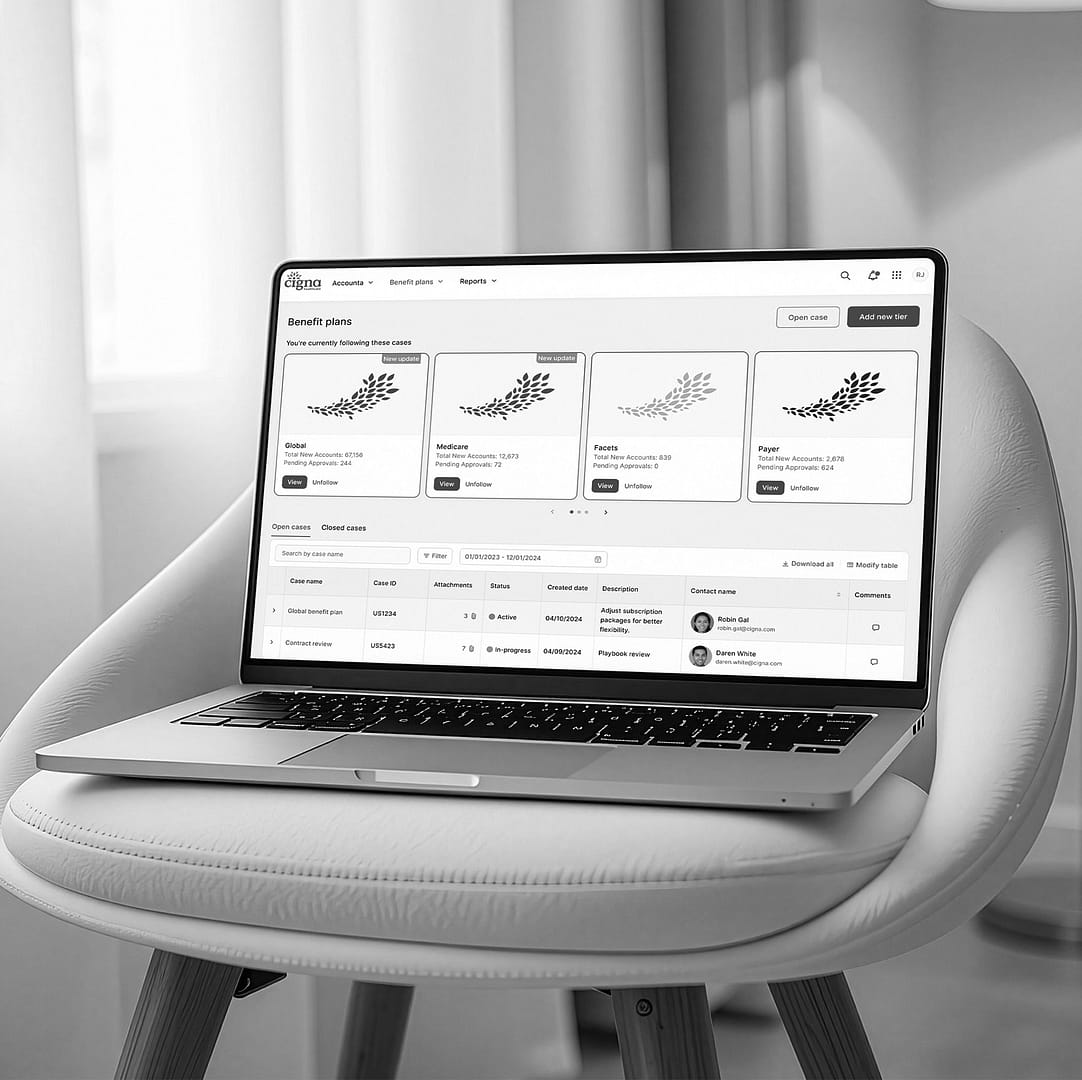
The result was a more modern and coherent enterprise experience that improved discoverability, simplified complex tasks, and strengthened both product quality and team maturity.

IMPACT
The reimagined experience improved task completion by 50% and reduced the time users spent searching for critical features.
It also created stronger conditions for onboarding, adoption, and long-term confidence by making complex tasks easier to find, easier to understand, and easier to complete. Beyond the interface itself, the work strengthened team alignment and brought more structure to how design decisions were made and carried forward.
