
Agentic AI Workflow Orchestration

Overview
Problem: Fragmented tools, inconsistent PRD and requirements structures, and manual workflows created significant inefficiencies across the software development lifecycle. Research was not consistently integrated into product planning, visibility across workstreams was limited, and teams were sometimes solving similar problems across different product areas without awareness of existing work. These gaps increased duplication, slowed research-to-product, design-to-engineering handoffs, delayed releases, and made it difficult to track decisions or maintain consistency across teams.
Solution: A human-in-the-lead agentic design operations model that operates through an Intelligent Workspace and enables Research, Product Management, UX, and Engineering to work within a more intelligently connected operating model supported by specialized AI agents. The workspace unifies the tools, workflows, and information each discipline relies on across research systems, email, calendars, Slack, Confluence, Jira, Figma, and GitLab to improve visibility into requirements, decisions, dependencies, design work, and handoffs throughout the software development lifecycle.
Using MCP servers, specialized AI agents, and orchestrated workflows, the model enables research insights to inform product requirements, surfaces related work across teams, strengthens continuity between disciplines, and supports more consistent documentation and delivery practices. Intentional tool selection, workflow standardization, governance, training, and staff upskilling support responsible AI adoption, helping teams integrate AI into day-to-day work while maintaining human judgment, validation, accessibility, quality, and accountability.
My Role and Impact: As Design Lead, I co-defined and led a human-centered AI operating model that transformed how Research, Product, UX, and Engineering worked together across the development lifecycle. I helped establish the foundational operating model, define agent roles and responsibilities, connect workflows across disciplines, evaluate and integrate AI tools, prototype the Intelligent Workspace experience, and lead adoption and upskilling across participating teams.
Within nine months, the model reached 80% adoption across participating teams, increased operational efficiency and AI engagement by 30%, reduced PRD and project-tracking setup from three hours to 10-15 minutes, and shortened concept-to-prototype cycles from six weeks to 10 days. It significantly improved cross-team visibility, reduced duplicated effort, strengthened consistency and traceability across the lifecycle, and created more capacity for strategic thinking and innovation.
My Scope Included:
- Establishing the human-in-the-loop agentic experience strategy, defining where AI agents should analyze, recommend, coordinate, or execute and where human judgment, approval, and accountability remained essential
- Architecting specialized Research, Product, Design, and Engineering agents with clearly defined roles, responsibilities, inputs, outputs, constraints, handoff points, and validation criteria
- Designing how agents and disciplines worked together across the lifecycle, connecting research evidence to product requirements, design decisions, engineering preparation, and implementation
- Defining AI skills and layered validation patterns that enabled agents to evaluate outputs, identify gaps in evidence or reasoning, surface dependencies, and determine readiness for the next stage of work
- Embedding customer evidence and agent-supported validation into PRDs, prioritization, design decisions, and implementation planning to strengthen traceability, consistency, and quality
- Prototyping the end-to-end Intelligent Workspace experience, gathering feedback, testing interaction and orchestration patterns, and iterating against established UX and agentic design principles
- Evaluating and integrating AI tools, MCP connections, and workflow automations across Slack, Confluence, Jira, Figma, GitLab, email, calendars, and research systems
PROCESS
DISCOVERY
The software development lifecycle itself had become fragmented across tools, teams, and ways of working.
Through internal interviews, workflow reviews, surveys, and ongoing engagement with product, design, and engineering teams, we identified recurring breakdowns: PRDs and requirements were structured differently across product areas, research was not consistently connected to planning and prioritization, and teams had limited visibility into adjacent work. Designers could spend time solving similar problems for different product owners without knowing that related patterns or solutions already existed elsewhere.
These inconsistencies created downstream effects across the lifecycle. Teams spent additional time reconstructing context, aligning requirements, tracking decisions, preparing handoffs, and reconciling duplicated work. The result was slower delivery, reduced visibility, and greater difficulty maintaining a consistent experience across products.
The discovery helped us to form a more strategic question: How might we create a more connected, consistent, and efficient development lifecycle, and use AI to strengthen the relationships between the people, tools, and decisions within it?
Strategy
My team and I approach the initiative as both an operating-model transformation and an agentic experience challenge. I lead the strategy and orchestration, translating fragmented cross-functional workflows into a practical first iteration we can build, test, and improve.
The strategy centers on three goals:
- Connect disciplines: Define clearer inputs, outputs, responsibilities, and handoffs across Research, Product, UX, and Engineering.
- Create continuity: Preserve research evidence, requirements, decisions, dependencies, and design rationale as work moves through the lifecycle.
- Apply AI intentionally: Define focused agent skills and orchestration patterns that use accessible data and approved tools to reduce repetitive coordination and accelerate work while keeping people accountable for key decisions.
This creates the intelligent architecture for a new SDLC model where AI is not a separate productivity layer. It becomes connective infrastructure between teams, helping improve consistency, reduce duplicated effort, and shorten the distance between insight and implementation.

Define
Working across design teams and a cross-functional group spanning Research, Product Management, UX, Engineering, and Quality, I established the foundational structure required for the new operating model.
Rather than introducing isolated AI tools into already fragmented workflows, I first map how work moves across Research, Product Management, UX, and Engineering, identifying where context, consistency, ownership, and visibility break down.
For the first iteration, I intentionally simplify the model around what we can reliably control: available data, clearly defined agent skills, existing workflows, and tools we already have access to. This allows us to establish a usable foundation before expanding autonomy or complexity.

This created a shared agentic foundation that I could prototype, test, measure, and continuously improve rather than allowing each team to independently create disconnected AI workflows.
I then translated that foundation into a human-in-the-lead, AI-in-action operating framework, establishing reusable skills, workflow patterns, validation criteria, and human checkpoints. People remain responsible for judgment, approval, accessibility, quality, and final decisions, while agents help reduce repetitive coordination, preserve context, identify gaps, and improve continuity across handoffs.

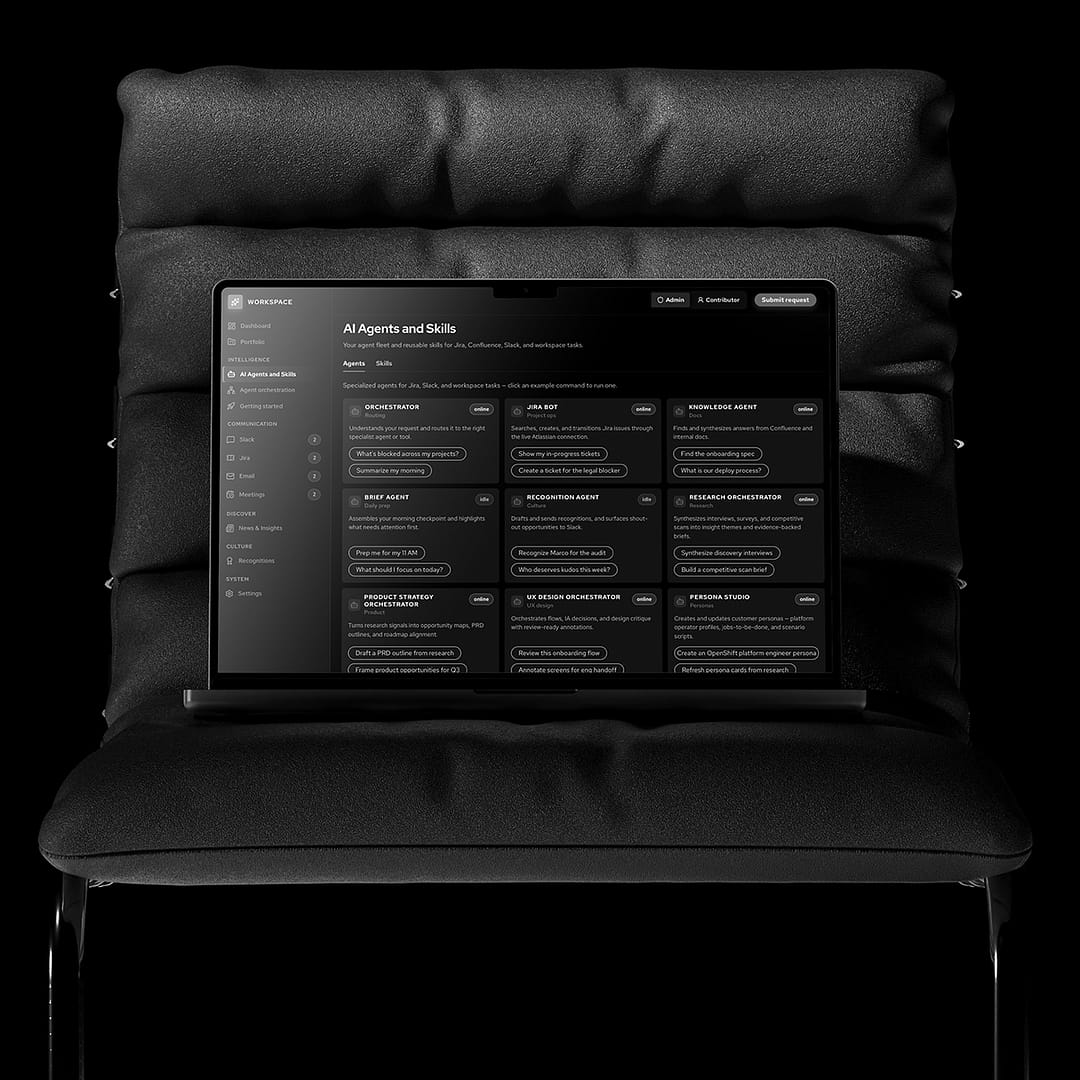
With the foundational roles and skills established, I designed and prototyped the Intelligent Workspace, connecting research repositories, Slack, email, calendars, Confluence, Jira, Figma, and GitLab through MCP servers, RAG, specialized agents, and orchestrated workflows.
Core components included:
- MCP servers for tool coordination and shared workflow context
- RAG agents that brought research insights to life
- Cursor and Ask for synthesis, planning, and task generation
- Jira for automated epic and ticket creation
- Slack, email, calendar events, and relevant news for daily summaries and priority signals
- Figma plugins for faster low- to high-fidelity wireframing and design-system outputs
- GitLab for rapid prototyping and tighter design–engineering collaboration
- Momentum for tracking progress, reviewing outcomes, and measuring impact
Consistency became especially important. Rather than every team inventing its own prompt structure, documentation format, or AI workflow, the system introduced reusable patterns for research synthesis, requirements, prioritization, validation, Jira creation, design preparation, and handoffs.

Through multiple iterations, I experimented with tools and evaluated the most effective workflows, agent dependencies, sequencing, handoffs, and human validation points to improve consistency, traceability, and efficiency across disciplines.
I approached orchestration as an application-development challenge, considering token usage, context size, latency, and operating cost alongside experience quality. Modular workflows, reusable agent skills, and intentional context management helped reduce unnecessary processing while keeping the system maintainable and extensible.
The result was a more efficient orchestration model that connected research to requirements, carried context into design, reduced duplicated work, and created clearer handoffs into engineering.
TESTING & SOCIALIZATION
I introduced the workflows with smaller groups and evaluated how effectively work moved between Research, Product, UX, and Engineering. Securing adoption required more than introducing agentic tools and Intelligent Workspace. My team and I created a structured enablement process that helped teams experiment safely, build confidence, and adopt new ways of working at their own pace.
The process was first tested with small groups and supported through monthly learning sessions, daily working sessions, 1-on-1 coaching, shared instructions, and reusable documentation. Every process, installation step, and example was made accessible so people could reproduce the work, develop their own agents, and build solutions independently. This support model helped us measure confidence, interest, and readiness while encouraging teams to see AI as a co-partner, one that could help them think, connect work, challenge assumptions, and create beyond the limits of a traditional search tool.

I had quietly hoped to explore this direction for a long time. With this initiative, I took it further to inspire others. What did I do? I created a new surface, a new way to experience research.

This became especially important in research, where valuable insights were often gathered, documented, and gradually lost across repositories, reports, tickets, and static artifacts. I developed an intelligent workspace, Edge Research Lab, that brought EAP insights, years of research into one connected environment and introduced an interactive layer across personas, user journeys, A/B testing, and real workflow scenarios.
Instead of asking stakeholders to read research after decisions had already been made, the system allowed them to engage with evolving, research-based personas they could question, test, and challenge as new data and market needs emerged. Researchers began installing the system and building their own agents, opening a path toward something I had hoped to explore for year, transforming research from a static deliverable into a living part of product development. The people we design for are more than data points, quotes, and journey maps. They represent real lives, constraints, motivations, and hopes. AI gave us a way to make that human context more visible, more actionable, and harder to ignore.

Validation with internal teams revealed that AI adoption did not progress at the same pace for every user group. Nearly 10% of teams were not ready to independently configure Cursor, connect MCP servers, integrate Figma, or apply the new workflows without additional support. Weekly podcasts, demos, and working sessions kept teams and stakeholders engaged, made the learning visible, and positioned the Intelligent Workspace as the central hub for operations, communication, effectiveness tracking, and experimentation.


The Intelligent Workspace system enabled teams to:
- Centralize the research insights to build an interactive workplace
- Automated Jira epics and tickets from meeting inputs and discussions
- Summarized daily communication and surfaced what mattered most
- Turned fragmented conversations into structured action view agentic ai outcomes
- Accelerated wireframe creation and reusable design system patterns
- Shortened the path from design concept to simulated prototypes
More broadly, it showed how agentic AI could support both team operations and design execution when applied with clear intent and workflow structure.

While power users adopted the model quickly, other teams required step-by-step guidance, working sessions, documentation, and repeated follow-up. Their adoption took three to four months rather than one week, reinforcing that successful AI transformation depends as much on enablement and confidence as it does on tooling.
This learning shaped my 5Ps adoption model:
People: Understand readiness, confidence, and support needs
Process: Define how AI fits into existing workflows
Practice: Create repeatable opportunities to learn through use
Policies: Clarify what teams can use, when to use it, and under what conditions
Posture: Socialize proven practices, get more buy-in, share outcomes, and continuously improve through feedback
The 5Ps helped us create a more inclusive adoption path that supported both advanced users and teams that needed more time, structure, and reassurance.
Within nine months:
- 80% adoption across participating teams
- 30% increase in operational efficiency and AI engagement
- PRD and project-tracking setup reduced from ~3 hours to 10-15 minutes
- concept-to-prototype cycles reduced from 6 weeks to 10 days
Beyond the measurable efficiency gains, the larger transformation was a more intelligent and advanced SDLC with less duplicated effort, greater cross-team visibility, more consistent requirements and documentation, stronger traceability, and clearer handoffs between disciplines.
The result is not simply an AI-enabled workflow. It is a more intelligently connected operating model where Research, Product, UX, and Engineering work with greater continuity, consistency, and efficiency.