
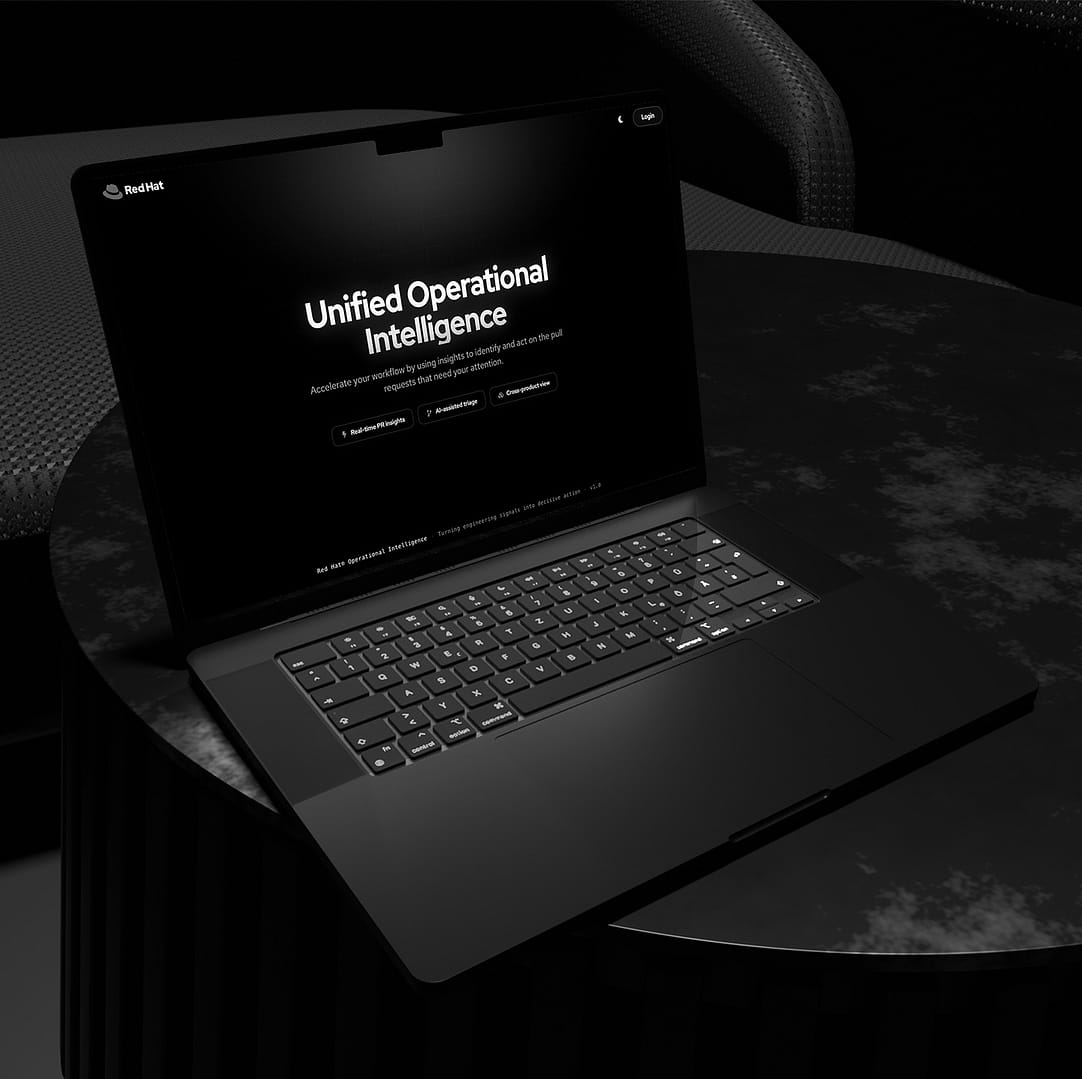
Red Hat Unified Operational Intelligence

Overview
Problem: RHEL, OpenShift, Ansible, and Lightspeed power mission-critical production environments. When updates introduce instability, they can disrupt complex systems built over years, interrupt business operations, erode customer trust, and overwhelm support teams. With support tickets increasing 20% year over year and $2 million in business already lost, release instability had become a systemic risk to customer retention, operational performance, and revenue.
Solution: A unified, AI-powered operational intelligence experience that connects the most critical signals across releases, products, engineering systems, customer impact, and SDLC workflows. It transforms fragmented data into clear risk intelligence, recommended mitigation strategies, and actionable resolution paths. Through an agentic experience, specialized agents continuously identify emerging release risks, explain the factors driving them, assess potential customer and business impact, and guide teams toward the right intervention before issues reach production environments.
My Role and impact: As the UX lead for an AI-powered operational intelligence initiative, I transformed an undefined concept into a validated product strategy and scalable experience foundation within six months. The solution was adopted by the first 25 teams by Q1 2026, established a path to support more than 100 teams, increased delivery efficiency by 30%, and contributed to $1 million in projected savings.
My scope included:
- Leading product discovery, planning, and definition across Product, Engineering, and leadership
- Shifting the initiative from technology-first assumptions to evidence-based user problems, role-specific workflows, and clear experience requirements
- Embedding UX principles into PRDs, backlog-grooming sessions, acceptance criteria, and initial launch planning
- Defining the human-in-the-loop Explain, Suggest, Act model for agentic AI interactions
- Prototyping the agentic experience within the actual product to make the future-state vision tangible and testable
- Introducing a code-based co-creation model that connected design and engineering in the same working environment
- Replacing static handoffs with functional, implementation-ready prototypes that accelerated validation, alignment, and delivery

UX Process
Discovery
Red Hat is known for its open-source, engineer-led culture. Because UX was new to this group, I saw an exciting opportunity to introduce Design Thinking into the team’s planning and decision-making process. I established collaborative working sessions and facilitated a cross-functional workshop to map the existing SDLC and release workflows, identify the highest-value opportunities, and align the team on where AI could support earlier risk detection before solution design began.


Note: AI-generated and modified to remove or anonymize confidential information.
Learnings
Through these working sessions and workflow-mapping activities, we identified two distinct needs:
- Team level: 9,000 engineers, ~47% of employees: Engineers and team leads needed early, explainable visibility into release risks, supported by evidence, severity, confidence, recommended actions, and human control.
- Product level: 500 senior leaders, ~3% of employees: Leaders needed cross-team intelligence to identify recurring risks, technical debt, testing gaps, unstable dependencies, ownership issues, and where AI required better context.
- Both level: all 19,000 employees: Individuals needed AI to explain risks, recommend solutions, and support approved actions while preserving human authority to accept, defer, escalate, or resolve.
DEFINE
By advocating for UX best practices, I translated complex interactions and journeys into clear artifacts that helped engineers and leaders align, engage, and move forward together. These artifacts emphasized the importance of a human-in-the-loop framework and continuous feedback across AI signal quality, engineering trust, repository health, release readiness, and team adoption. They also demonstrated how earlier detection and resolution of release risks could help teams prevent defects, regressions, and release failures from reaching customers.

Through close collaboration with product and engineering, I embedded UX principles directly into the PRD and backlog-grooming process for the initial launch. By consistently grounding discussions in the customer problem and intended experience, I influenced how requirements were framed and evaluated.
Together as a team we began defining the problem statement, proposed solution, user needs, and acceptance criteria before moving into technical implementation. For many engineers, this introduced a new way of working: starting with the experience, then determining how technology should enable it.
Iterate
We explored multiple concepts to define how data, workflows, and AI assistance should come together as one cohesive experience. Two tiger teams tested different approaches in parallel: one extending Grafana, while my team designed a fully customized experience, moving from Figma Make into code-based, high-fidelity prototypes.
The first iteration was critical in exposing where the experience was breaking down. It showed me that users needed a much smoother transition between the selected product, the teams embedded within it, and the tools or support available to move work forward. Early testing surfaced navigation friction, usability issues, and unnecessary complexity, which gave me a clear direction for simplifying the flow.
I worked closely with engineers from the beginning, sharing low-fidelity wireframes so they could challenge the interaction model, identify technical constraints, and influence the experience before we invested in higher-fidelity design.
Unified Operational Intelligence experience (AI-augmented, low-fidelity, iteration 1)

As the concept matured, I moved into mid-fidelity wireframes and brought senior leaders into the feedback loop. That uncovered an important insight: the value of the experience depended heavily on who was using it and what decision they were trying to make. That changed how I thought about the product. Rather than designing one dashboard for everyone, we created a foundation for an adaptive experience where navigation, information density, and data representation changed based on the user’s role, goals, and responsibilities.
Unified Operational Intelligence experience (AI-augmented, mid-fidelity, iteration 2)

The iteration eventually evolved into a high-fidelity, code-based product experience, which pushed my thinking beyond usability and simplification. Building closer to the real product helped me better understand orchestration, data lakes, system dependencies, and how information moves across the experience. It also opened a new design question: how do we make a complex enterprise system not only easier to use, but more engaging and joyful? From there, I began exploring richer interactions, dynamic data experiences, and more responsive ways for users to move between insight, decision, and action.
Contributor experience (AI-augmented, code-based high-fidelity, light mode)

Admin experience (AI-augmented, code-based high-fidelity,light mode)

My focus was not to introduce an agent as a separate destination, but to make AI assistance feel like a natural extension of the existing workflow. The experience begins human-led, with users exploring data, identifying issues, and making decisions through familiar product interactions. As context becomes relevant, the agent progressively assists by interpreting signals, explaining what is happening, and recommending next steps without taking control.
AI agent experience (AI-augmented 3 iterations)

I designed this around a human-in-the-loop model:
- Explain: surface the issue and provide context appropriate to the user’s role.
- Suggest: recommend possible next steps while communicating confidence, uncertainty, and required input.
- Act: execute through Jira, GitLab, or Slack only after explicit user approval, then confirm what changed and where it can be reviewed.
I defined the assistant as an adaptive operator, embedded within the workflow rather than a separate chat experience. Its tone and level of detail adapted by role: strategic and concise for leaders, more technical and actionable for contributors, creating a personalized experience based on role, context, and task (phased approach)
This progression from human-led → agent-assisted → human-approved action allowed me to prototype not only how AI could function, but how it should feel within the product: contextual, consistent, permission-aware, and integrated into the user’s existing process.

Validation
Testing with AI-augmented rapid prototyping revealed two clear role-based needs:
- 98% of leaders and administrators wanted a high-level view of product performance, team activity, emerging risks, and areas requiring immediate attention.
- 75% of contributors wanted detailed team-level insights, including AI-predicted failure analysis and visibility into whether recommendations were accepted, rejected, or ignored.
These findings shaped role-based detailed dashboard views, progressive levels of data, and permission controls across product, team, and repository levels.

As the experience matured, backend integration became a critical part of the strategy. The value of Unified Operational Intelligence depended not only on the interface, but also on how effectively data, workflows, risk signals, and insights could be orchestrated behind the scenes and surfaced at the right moment to support better decisions.
Execute
To accelerate learning and create stronger alignment early, I used Figma Make to explore initial concepts and bring the team into the process through rapid feedback. I then advanced the strongest directions into working prototypes in Cursor, allowing us to test the experience in more realistic scenarios, refine interactions with engineering, establish reusable UI patterns, and create a clearer path from concept to implementation.

I hosted the code securely in GitLab, and integrated n8n to bring real data into realistic end-to-end scenarios, from detecting a release risk and reviewing evidence to selecting an action and tracking resolution. I invited engineering partners into the GitLab project and assigned Developer or Owner permissions based on their responsibilities. This shared environment allowed design and engineering to collaborate directly using Cursor and Claude, accelerate decisions, improve implementation consistency, and create a clearer path to production.


Engineers had the appropriate Developer or Owner access to review, refine, merge, and deploy changes in real time. Instead of translating static design files through a separate handoff phase, the team worked from a shared source of truth. This preserved design intent, reduced implementation loss, accelerated iteration, and moved validated experience decisions directly toward production.

Impact
The initiative improved more than operational efficiency. It created a more proactive and secure approach to building and releasing products by enabling teams to identify risks earlier, test realistic scenarios, iterate before implementation, and address potential failures before they reached production.
The solution:
- Increased delivery efficiency by 30%
- Contributed to $1M in projected savings
- Scaled from an initial 25 teams toward 100+ teams
- Enabled earlier detection and validation of release risks
- Strengthened product security and release resilience by helping teams identify vulnerabilities, dependencies, testing gaps, and potential failures before production
Ultimately, the work shifted teams from reacting to production failures toward identifying, testing, and mitigating risk earlier in the development lifecycle.