
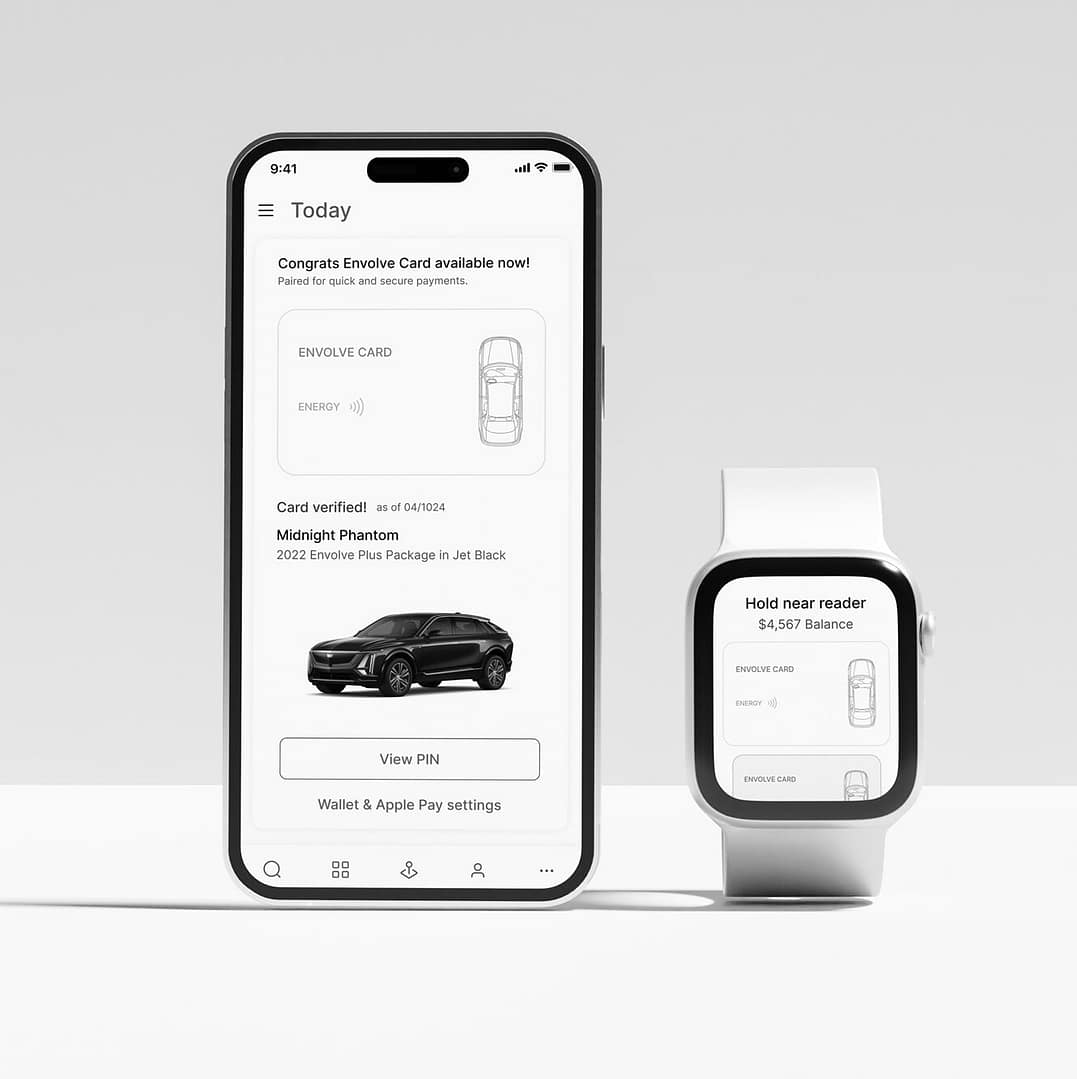
GM Envolve Financial Services

Overview
Problem: Fleet customers struggled to discover, understand, and adopt GM Financial services because commercial cards, digital setup, assignment, and expense management were fragmented across the GM Envolve ecosystem. Low visibility and complex workflows limited use of high-value financial offerings, reduced customer confidence, and constrained business growth.
Solution: A connected commercial financial experience that brought credit application, card setup and assignment, digital card management, and expense controls into one guided journey, surfacing relevant services within real fleet tasks, adapting workflows to fleet-manager and driver roles, and creating reusable patterns for future financial offerings.
My Role and Impact: As UX Team Lead, I led the end-to-end experience strategy and design for GM’s first commercial card experience, transforming customer research, behavioral insights, operational requirements, and business priorities into a scalable financial product experience for GM Fleet customers. Working across GM Financial and GM Envolve, I brought together senior business leaders, product, research, engineering, and domain experts around a shared mission: make it easier for fleet customers to access, activate, and manage the financial services that help their businesses operate and grow. I established the experience vision across the customer lifecycle, from application and approval through card assignment, digital setup, controls, and expense management, while creating a foundation that could expand into broader credit, rewards, and financial-management capabilities across the GM Envolve ecosystem. The resulting experience contributed to a 20% increase in applications and a 90% increase in adoption.
My scope included:
- Connecting two major GM business organizations around a shared experience strategy for commercial and fleet customers across financial and mobility services
- Translating customer research into actionable artifacts that defined human-centered journeys and opportunities for the next generation of the commercial card ecosystem
- Establishing a connected end-to-end lifecycle across credit application, digital activation, and expense management, unifying fragmented experiences
- Using behavioral evidence to challenge internal assumptions and redesign the expense-management experience across GM Envolve and GM Financial users
- Defining product success metrics and experience KPIs to create a continuous feedback loop, surface friction, validate design decisions, and guide ongoing iteration


UX PROCESS

Discovery
I led discovery to uncover systemic breakdowns across the financial experience, not just surface-level usability issues.
By synthesizing customer insights, behavioral patterns, and workflow gaps, I found that the core challenge was not simply feature awareness, but a disconnect between financial tools and the moments when customers actually needed them.
I partnered with research and product teams to validate these insights and shift the approach from feature-level improvements to a more journey-driven model, where premium services, digital cards, and expense management could be surfaced in more relevant, timely, and actionable ways.


UX strategy
The strategic focus was to shift the experience from fragmented transactions to a connected financial model that could support both immediate user needs and long-term business growth.
To do that, I centered the work around three priorities:
- making financial services easier to discover in the context of real fleet tasks
- reducing friction across the most adoption-critical workflows
- building a scalable structure that could support multiple user roles, business rules, and future offerings
Rather than treating cards, setup, and expense management as separate functions, I shaped the experience as one connected system. This helped align customer needs, business goals, and operational realities into a clearer product direction.
Vision
The designs helped drive cross-functional alignment around a unified vision for a more scalable financial experience that supports customer growth through credit and expense management, while repositioning rewards and financial tools as integrated everyday enablers rather than standalone services.


Define
I translated insights into structured user flows aligned to real-world roles and behaviors. This included:
- role-based experiences for fleet managers and drivers
- simplified step-by-step workflows for critical tasks
- clear entry points for financial features across the ecosystem
The result was a more guided and personalized experience that reduced friction and improved task completion.


Ideation
We explored multiple concepts to turn customer and business needs into scalable product flows.
This phase focused on:
- mapping use cases into end-to-end workflows
- aligning user and business needs through a shared value model
- prioritizing features into phased delivery
Key insights from testing:
- 95% of users preferred assigning cards to drivers first, then setting expense limits based on usage
- 50% found PIN reassignment confusing, showing the need for a more intuitive interaction
Actions taken:
- redesigned the workflow to prioritize card assignment before expense limits
- introduced a refresh icon to simplify PIN reassignment
These changes made the experience more natural, more efficient, and better aligned with how customers actually manage fleet spending.
Ideation I & II- Financial Guard

Execution
The final experience brought together credit application, card setup with assignment, and expense management into one connected journey.
The work transformed a fragmented process into a clearer and more scalable experience that supported both customer needs and business goals. By improving discoverability, simplifying critical workflows, and aligning the experience to real fleet behaviors, the solution created a stronger path to adoption and ongoing engagement.


