
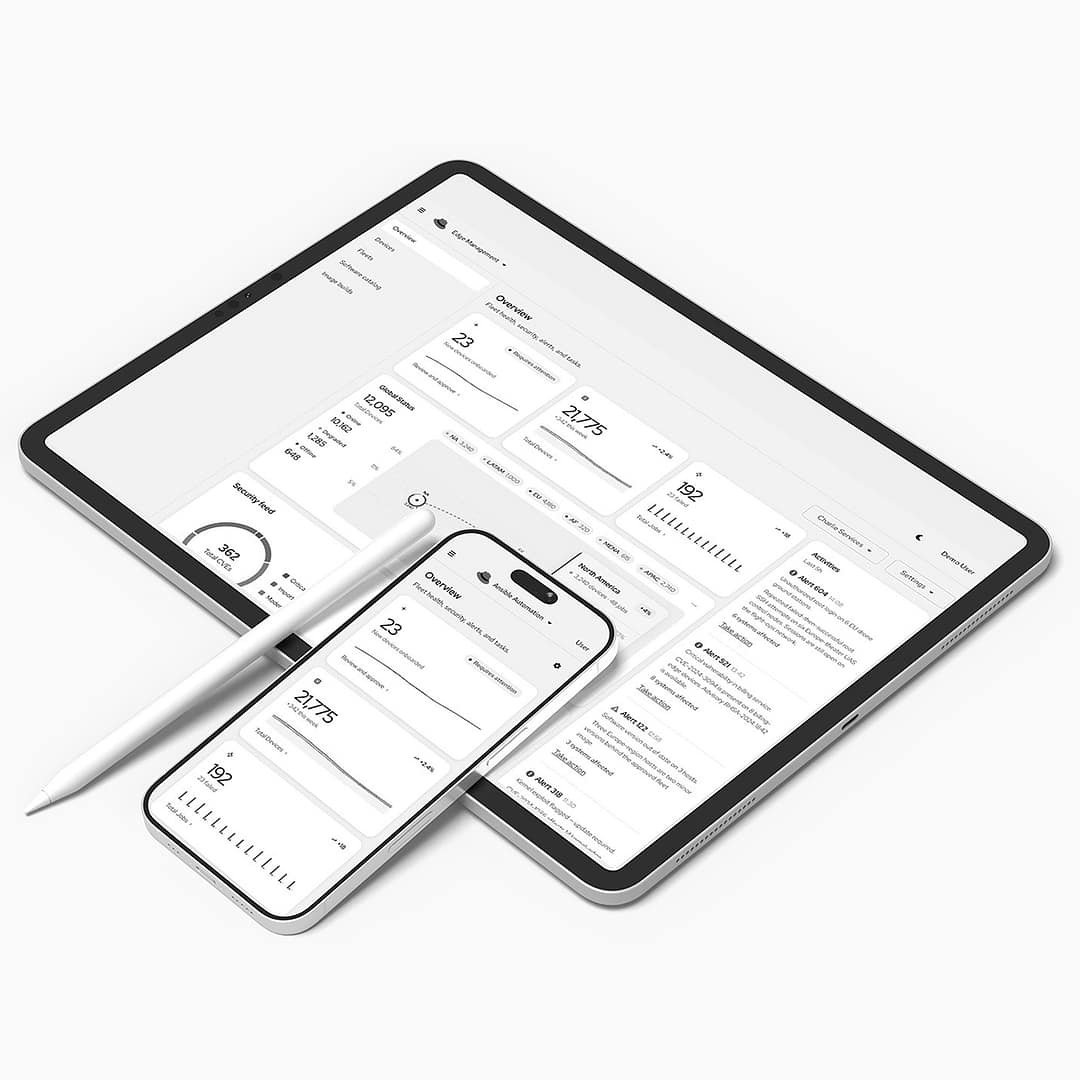
Red Hat Agent-led Edge Computing

OVERVIEW
Problem:Across manufacturing facilities and defense logistics networks, OT teams manage thousands of edge devices through fragmented tools, manual processes, and reactive workflows. Many operators need a simpler, more intuitive way to understand system health, identify risks, and act before issues escalate. When insight is difficult to interpret or action comes too late, operational failures follow. Large industrial facilities lose an average of 27 production hours each month, automotive downtime can cost up to $2.3 million per hour, and incident responders spend 38% of their time on manual processes, generating as much as $700,000 in annual operational toil.
Solution: An agent-led edge management platform that gives technical and non-technical operators one intelligent environment to onboard devices, monitor fleet health, manage applications, and identify vulnerabilities before they escalate into operational failures. Beneath the interface, an agentic layer continuously evaluates every connected device at 60-second intervals, detects emerging risks, initiates automated recovery, and restores affected devices to their last known secure state when predefined conditions are met. Rather than waiting for operators to respond after a disruption, the platform shifts edge management from reactive intervention to continuous prevention.
My Role and impact: Within a 15-person engineering and architecture team, I served as UX Lead, bringing enterprise UX strategy, research rigor, and scalable design practices to a $10M edge management platform. I helped shift the team from technology-led assumptions toward validated customer needs, establishing an adaptable experience architecture and reusable design foundation that enabled teams to move from early product definition to GA readiness and enterprise launch within six months. The foundation supported onboarding with customers including Eli Lilly and Lockheed Martin and was designed to scale across evolving products, AI workflows, and enterprise use cases.
My scope included:
- Leading UX strategy and experience integration across Edge, Ansible, and OpenShift, connecting fragmented capabilities into a cohesive platform experience
- Defining the 0-to-1 experience roadmap for a scalable, adaptable edge management ecosystem, including emerging agentic capabilities
- Guiding a small design team, setting priorities and strategic direction while helping designers anticipate challenges, navigate dependencies, and make confident decisions
- Shifting product decisions from technology-led assumptions to customer evidence, introducing validated needs, behaviors, and workflows earlier in the development process
- Shaping the agentic experience model, defining how the system understands users, surfaces intelligence, and guides action within a clear human-in-the-loop framework
- Driving cross-functional alignment across Product, Engineering, Research, and Business, translating complex technical capabilities into shared experience priorities and direction
- Championing an AI-augmented, code-based design process, establishing functional, implementation-ready prototypes and tighter design-engineering collaboration

UX PROCESS
DISCOVERY
The team consisted of 15 engineers and architects with deep technical expertise, but no clear product roadmap, customer research, or shared vision for General Availability, Feb, 2026. The product was being shaped primarily around assumptions and existing technical capabilities, creating a significant risk: we could build something technically impressive that customers did not understand, value, or adopt.
I recognized a critical need to bring real customer evidence into the room. Through the Early Access Program, I recruited 10 enterprise clients across manufacturing, defense logistics, and distributed infrastructure, giving the team something it had never had before: direct insight into the people who would buy and use the product. I led research sessions and interviews with enterprise partners, including Eli Lilly, ABB, Cox Automotive, and Lockheed Martin. What we heard reframed the entire initiative. Two distinct groups were shaping the product’s success, and each needed something different.
- Buyers were focused on business outcomes: reducing operational costs, strengthening security visibility, maintaining consistent performance across distributed sites, and scaling without adding headcount.
- Users needed clarity and control: a fast path to connect a device, an understandable view of fleet health, and the ability to resolve a problem without needing to understand the infrastructure operating beneath the experience.
Until that point, these needs had never been brought together within a single product strategy. The research gave us the foundation to connect business value with a usable, trusted experience, and begin shaping a product that could succeed with both buyers and users.

That finding changed the strategic direction of the product. It told the team exactly where to put our energy for the first release and why. Earn trust with the core experience first. Then introduce intelligence on top of it. The 10% of customers open to AI and automation were not rejecting it. They were telling us the order of operations. Foundation before intelligence. Reliability before automation. For the first time, product, engineering, and design had a shared evidence-based picture of who they were building for and what each person needed to succeed.
Buyer personas

User personas

Through close partnership with product and engineering teams, I translated research insights into product themes, JTBDs, prioritized capabilities, and phased experience recommendations. This helped the team understand what needed to launch first for GA 1.0, what could evolve next, and how each release could move us closer to the desired future-state experience.

At enterprise scale, teams often move quickly within their own product areas, and over time it can become difficult to maintain visibility across shared customers, timelines, and dependencies. I looked inward to better understand those connections. I evaluated existing workflows, intake processes, risks, and product surfaces to identify where teams could align earlier and share more context. The findings reinforced what we had already heard from customers: the products were part of the same experience, even though they were being developed through different paths. I introduced a more connected way of working that helped teams share context sooner, understand cross-product dependencies, and make decisions with the broader customer journey in mind.
High-level


The transition to AI-augmented, code-based prototyping was intentional and pragmatic. I continued using Figma where it created the most value for alignment, commenting, and tracking, while gradually moving the end-to-end experience into GitLab with Cursor and Claude supporting the shared technical environment.
CVE experience (AI-augmented, mid-high fidelity, iteration 2, light mode)

EXECUTE


That direction did not exist in isolation. IBM and Red Hat’s combined commitment, backed by a $5 billion investment in AI and agentic capabilities, created the strategic environment that made this work possible and gave it a larger stage to land on. The platform we built was not ahead of its time. It was exactly on time, aligned to where the business was already moving and ready to grow alongside it.
Integrated across OpenShift, RHEL, and Ansible (AI-augmented, light mode)
A scalable, modular navigation and experience framework connecting Edge, Ansible, and OpenShift through unified information architecture, portable navigation, and shared components, reducing experience redundancies by 30%.

